 comparative dictionary of
 Introduction to the dictionary
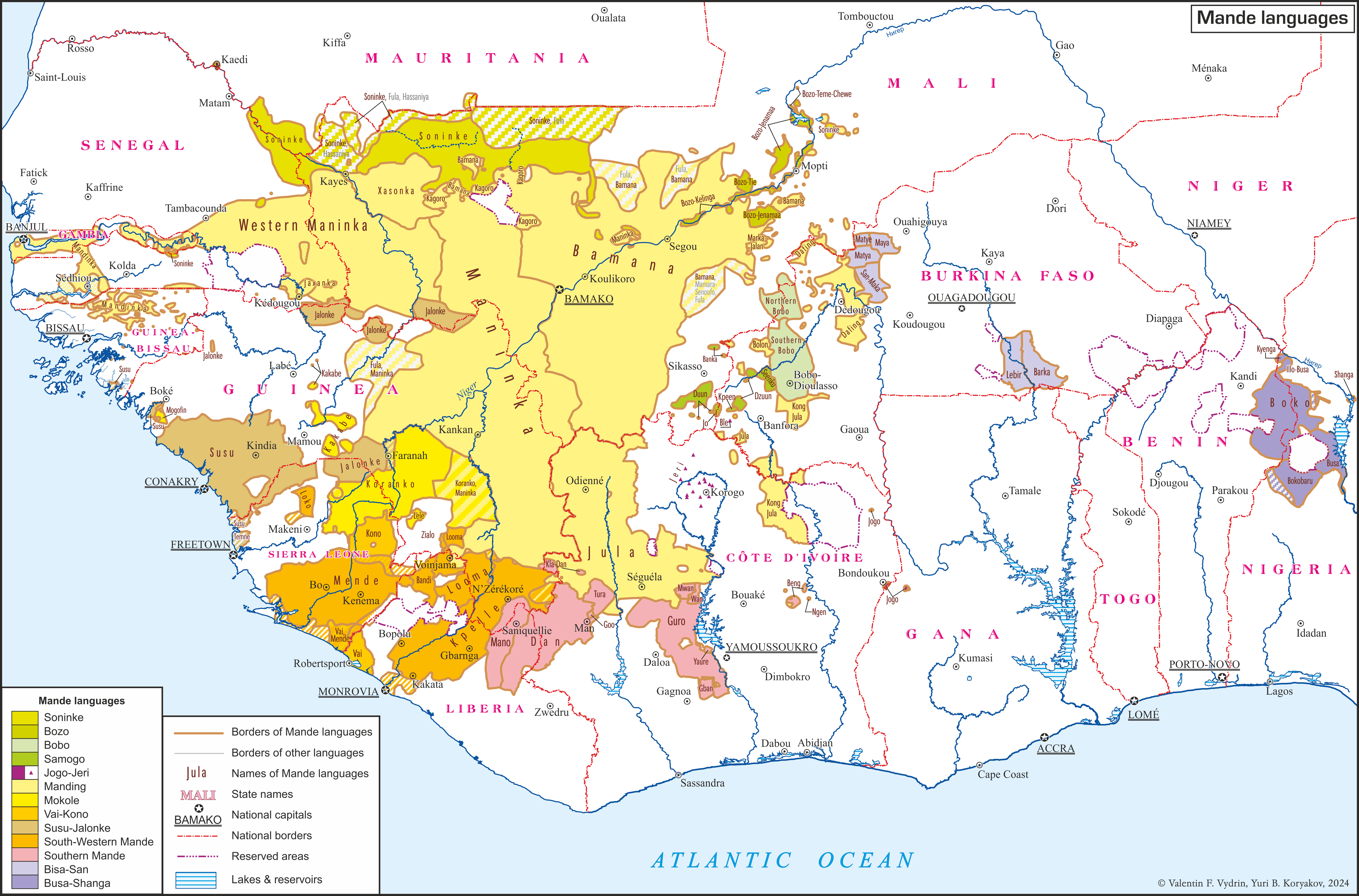
The Mande family is a major family of languages from Western Africa. It extends from Senegal in the West to Nigeria in the East; and from Mauritania in the North, to Liberia in the South (map). It is believed to include approximately 75 languages (not counting their dialects).
The comparative dictionary of Mande
The Mande project
My work on the comparative lexical database of Mande languages began in the 1980s. Initially, I would write words by hand on cards. In 1999-2000, I started my work on a comparative dictionary using the Toolbox software, and little by little all my data migrated from the cards to the electronic file. Ever since, I have been adding further data from new sources. This is work in progress, in two ways: new sources of lexical data for various Mande languages keep appearing; and also, further cognates continue to be found as old sources are explored more thoroughly.
The comparative database was first posted online in November 2024, initially on the site of the LLACAN laboratory, and later on a separate page.
In December 2025, the EvoLex team converted the database into the EvoLex format, so it could be incorporated into their series of comparative dictionaries. This version was released to the public in January 2026.
As of early 2026, the entire number of entries in the database is 3944.
This comparative lexical database of Mande languages will be updated regularly as new data is added.
Note on reconstructions
The dictionary is organised in entries, where each entry represents one cognate set. In other terms, an entry represents one potential Proto-Mande root, and its reflexes in the contemporary Mande languages. Entries vary greatly in the degree of their elaboration; some entries contain cognate forms from only two or three languages, while others include dozens of cognates, representing all the groups in the Mande family.
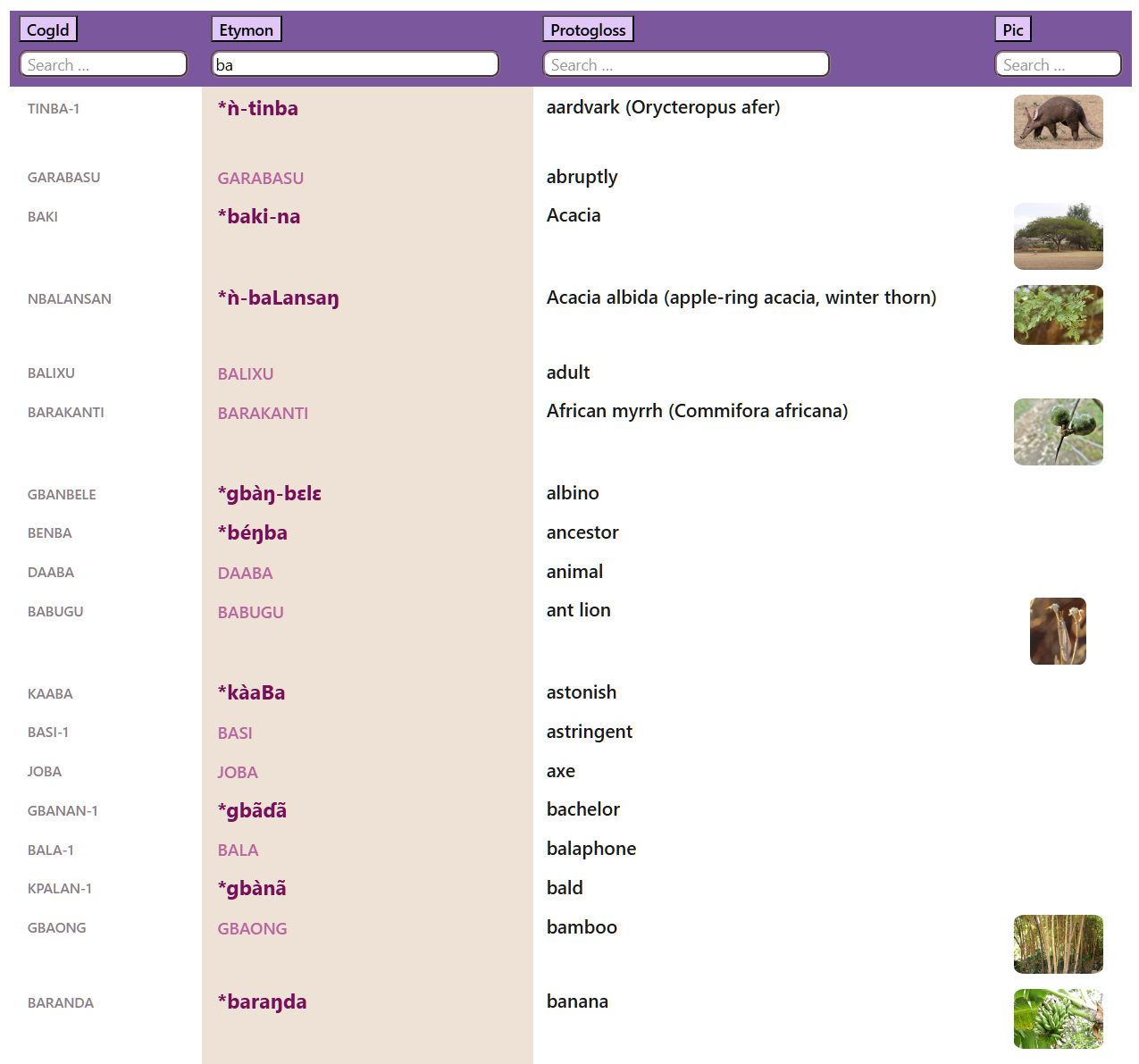
For about 15% of entries, I am proposing preliminary Proto-Mande reconstructions, i.e. protoforms. These appear as “starred forms”, i.e. lowercase words preceded by an asterisk, transcribed in IPA — e.g. *gbànã ‘bald’, or *ɗɔ̰̀ɔ̃ ‘be able’. These protoforms represent a preliminary hypothesis (reflecting the current stage of my studies in the field) on how the ancestral etymon must have sounded in the Proto-Mande language. Similar protoforms are also proposed for intermediate protolanguages, i.e. the ancestors of groups within the Mande family.
For most entries, the work of reconstructing a protoform still needs to be carried out. Such entries are represented using a simplified form, without the conventional asterisk, and in capital letters. This is the case, for example, of NEMU ‘forget’, or GBUNDU ‘secret’. Such uppercase forms should not be read as reconstructions: rather, they are mere identifiers or phonetic keys to help refer to the cognate set. (They are used, for example, in our URLs, even when a more accurate protoform has been reconstructed.)
There are numerous cognate sets that cannot, in fact, be traced back to the Proto-Mande level. Thus, the dictionary includes loans from non-Mande languages, especially when they present some interest for the historical comparative study of Mande. Examples include JAMA ‘crowd’ or QABILA ‘tribe’, both borrowed from Arabic. Of course, I do not mean that such loans are reconstructible to the Proto-Mande level (or at some intermediary proto-levels); I simply use the phonetic key as a way to capture the set of modern words descended from that shared root.
Structure of the family
According to Vydrin (2009), the Mande language family is subdivided into 11 groups. They form two branches, shown on the map:
1. Western branch
1.1. Southwestern Mande
1.2. Susu-Jalonke
1.3. Jogo-Jeri
1.4. Vai-Kono
1.5. Mokole
1.6. Manding
1.7. Soninke-Bozo
1.8. Bobo
1.9. Samogho
2. Southeastern branch
2.1. Eastern Mande
2.2. Southern Mande.
As for the present database, it shows considerable variation in the degrees of elaboration for individual Mande subgroups. As of January 2025, the groups that are best elaborated in the database are Southwestern, Manding, Soninke-Bozo and Southern (and yet, further improvement is necessary even for these groups).
As a rule, group-level reconstructions will be provided for:
- the Southwestern group (mainly based on Vydrine 1989; Kastenholz 1997; Vydrin 2006);
- Manding (based on Creissels 1979; Pozdniakov & Vydrine 1986; Pozdniakov & Vydrin 1988; Kastenholz 1997);
- Soninke-Bozo, based on an unpublished reconstruction by myself;
- the Southern group (based on Vydrin 2007).
Occasionally, tentative reconstructions for other groups may be provided as well; in particular, Proto-Eastern reconstructions by Schreiber (2008), although questionable, are often given. If no source is indicated for a reconstruction, it means that it is my own.
The right column of each cognate set cites references to the source of information. The full list of sources will soon be made available in a dedicated Sources page. If no reference is given, it means that the data or the reconstruction is my own.
Using this dictionary
The present dictionary follows the general layout of the 𝓔𝓿𝓸𝕃𝕖𝕩 series of comparative dictionaries, whose general principles are presented in its own homepage. We sum up here the main aspects.
An 𝓔𝓿𝓸𝕃𝕖𝕩 dictionary consists at least of two page types:
- an index of etyma as reconstructed for certain protolanguages [example]
-
and, (if you click on one of the “etyma” on that list)
a detailed entry displaying the entire cognate set under that etymon [example]
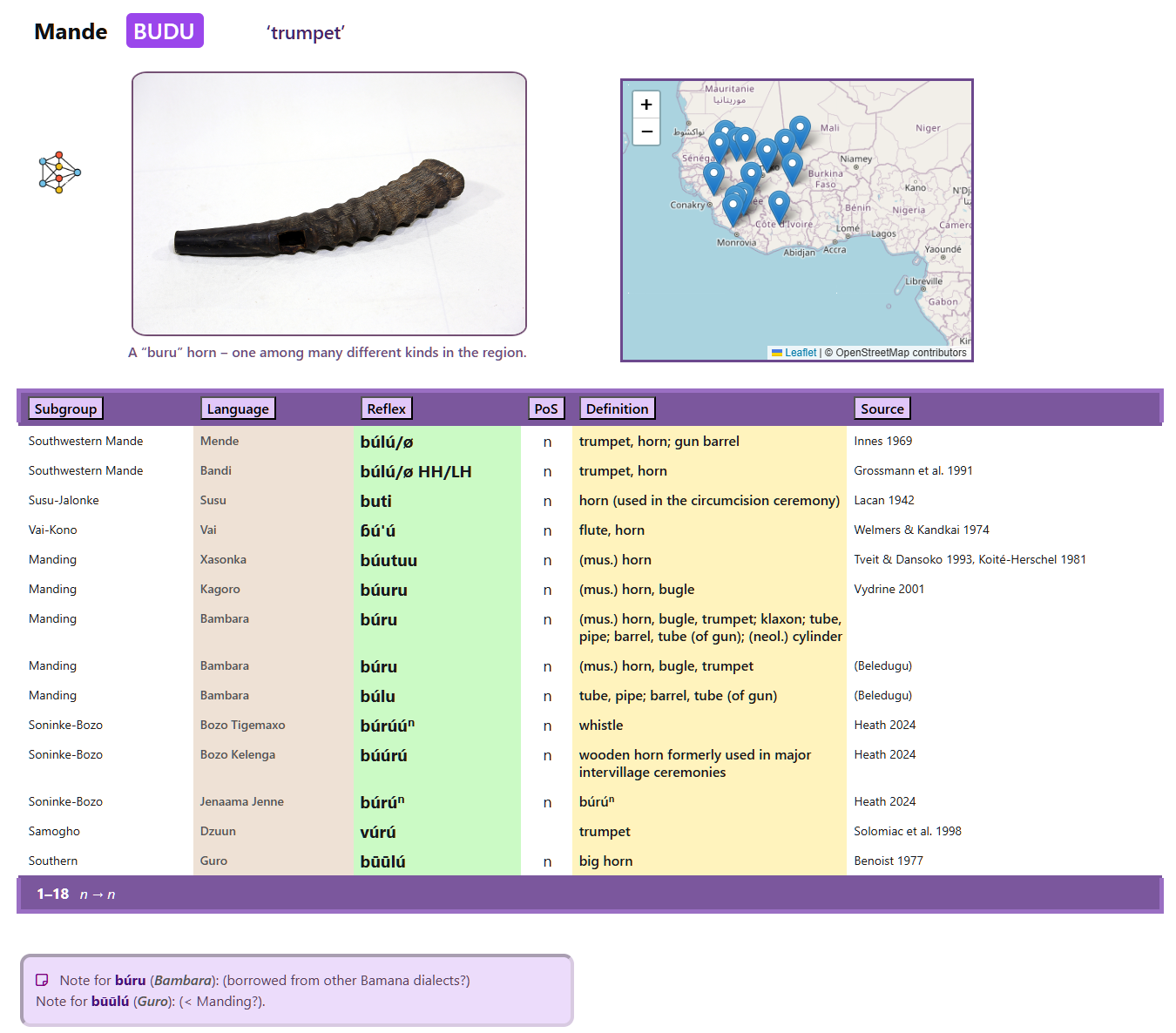
For detailed explanations about the structure of such entries, see the general introduction to the 𝓔𝓿𝓸𝕃𝕖𝕩 series of comparative dictionaries.
Valentin Vydrin, February 2026.
Valentin Vydrin is a Professor of Linguistics at Paris-based INALCO,
in the LLACAN department of African languages.

References
Creissels, Denis. 1979. Etude comparative du consonantisme de deux parlers manding (mandinka - bambara). Bulletin de phonétique de Grenoble 8. 99–155.
Kastenholz, Raimund. 1997. Sprachgeschichte im West-Mande. Methoden und Rekonstruktionen. Köln: Rödiger Köppe Verlag.
Pozdniakov, Konstantin & Valentin Vydrin. 1988. Rekonstruktion des phonologischen Systems des Pramanden. Zeitschrift für Phonetik, Sprachwissenschaft und Kommunikationsforschung 41(3). 353-371.
Pozdniakov, Konstantin & Valentin Vydrine. 1986. Die Entwicklung des phonetischen Systems des Pramanden: Nasalität und Entwicklung des phonologischen Systems des Manden-Sprachen. Zeitschrift für Phonetik, Sprachwissenschaft und Kommunikationsforschung 39(5). 549–561.
Schreiber, Henning. 2008. Eine historische Phonologie der Niger-Volta-Sprachen (Mande Languages and Linguistics / Langues et Linguistique Mandé 7). Köln: Rüdiger Köppe Verlag.
Vydrin, Valentin. 2006. K rekonstrukcii fonologicheskogo tipa i imennoj morfologii pra-mande (К реконструкции фонологического типа и именной морфологии пра-манде) [Toward reconstruction of the phonological type and nominal morphology of Proto-Mande]. In Nikolaj Kazanskiy (ed.), Mandeica Petropolitana (Acta Linguistica Petropolitana. Trudy Instituta lingvisticheskikh issledovanij RAN (Труды Института лингвистических исследований РАН) [Acta Linguistica Petropolitana. Transaction of the Institute for linguistic studies] II (2)), 3 246. St. Petersburg: Nauka. (Pdf version).
Vydrin, Valentin. 2007. South Mande reconstruction: Initial consonants. In Anna V. Dybo, Vladimir A. Dybo, Oleg A. Mudrak & George S. Starostin (eds.), Aspects of comparative linguistics (Orientalia et Classica. Papers of the Institute of Oriental and Classical Studies XI), vol. 2, 409v498. Moscow: Russian State University for the Humanities.
Vydrin, Valentin. 2009. On the problem of the Proto-Mande homeland. Journal of language relationship 1. 107–142.
Vydrine, Valentin. 1989. Reflection of the nominal classification in Manden and South-Westren Mande: the classification category. Zeitschrift für Phonetik, Sprachwissenschaft und Kommunikationsforschung 42(1). 90–101.
