 series of comparative dictionaries
series of comparative dictionaries
series of comparative dictionaries
𝓔𝓿𝓸𝕃𝕖𝕩 is a series of online comparative dictionaries in different language families.
It was created in 2025 by Alexandre François & Mathieu Dehouck (CNRS—LaTTiCe),
as a companion to their other project 𝓔𝓿𝓸Sem – the database of polysemous cognate sets across the world.
Each 𝓔𝓿𝓸𝕃𝕖𝕩 dictionary serves a double function:
There are currently two dictionaries in our 𝓔𝓿𝓸𝕃𝕖𝕩 series:
Besides these first two dictionaries, we are currently developing dictionaries for other language families: in particular, Pama-Nyungan (Australia) and several families of the Americas.
An EvoLex dictionary consists at least of two page types:
The main reference page to browse this dictionary is the index of etyma, which lists all the reconstructions present in the dictionary:
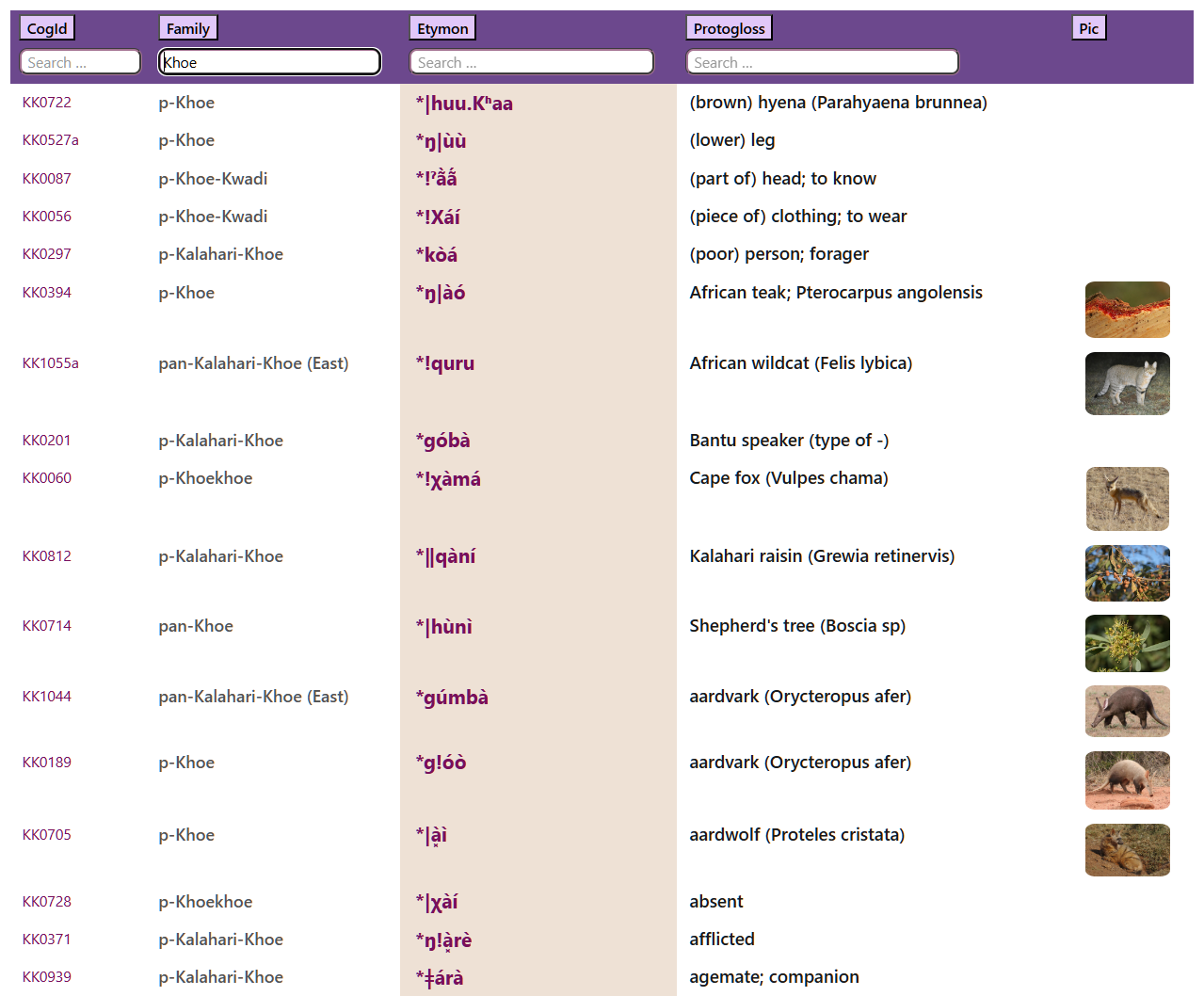
This list of cognate sets can be sorted by clicking on the different column headers, which include:
Each column can be filtered by typing in the “Search” box on the top of each column: see the second column in the screenshot. In order to open a cognate set, click on the etymon in the central column (or on the picture if there is one).
Each individual entry presents a cognate set – i.e. a set of modern forms that historically go back to the same ancestral etymon. As an example of such an entry, consider proto-Kalahari-Khoe *g!ùí ‘rope made of Sansevieria’:
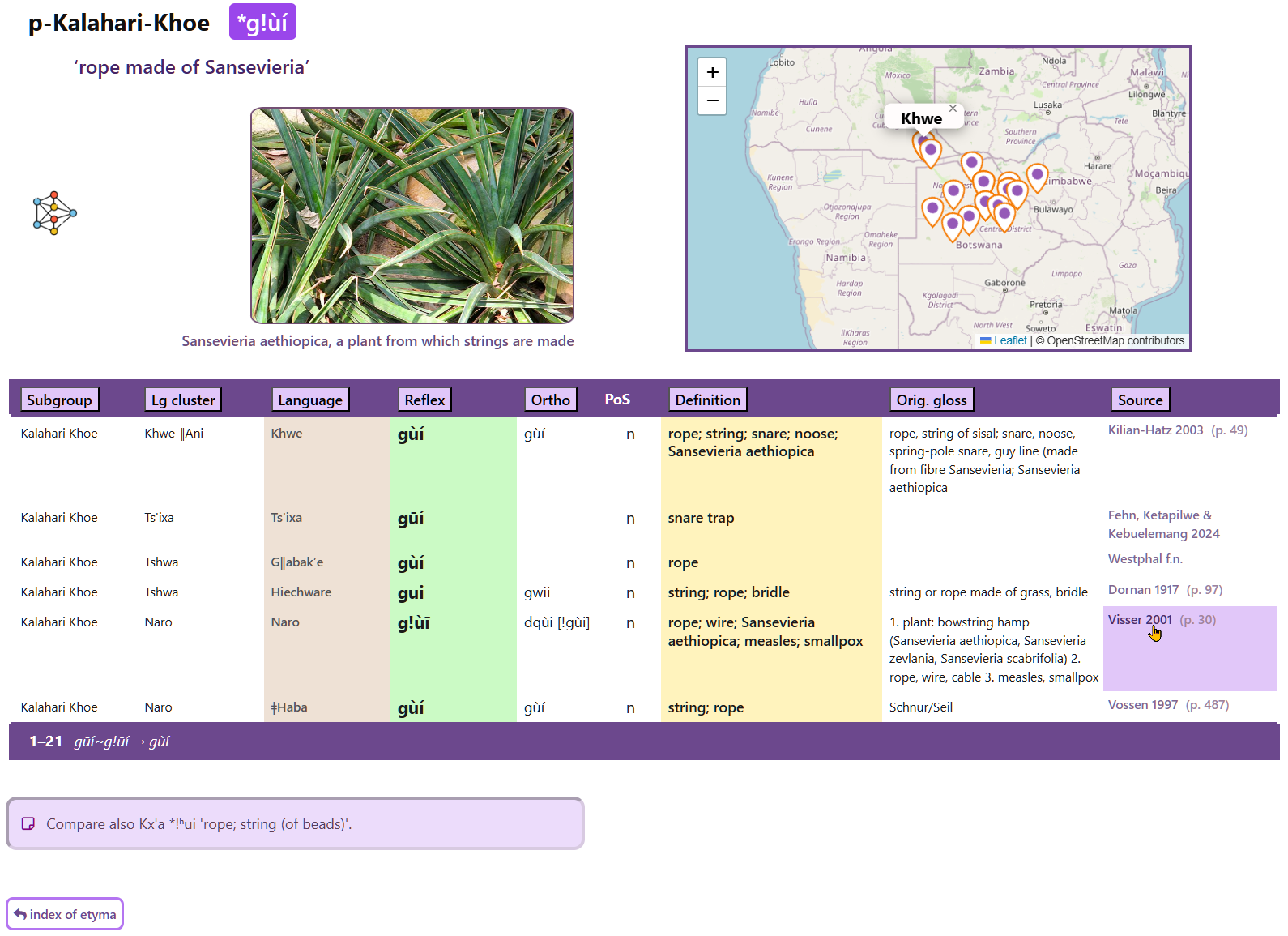
From top-left to bottom-right, an entry consists of a number of elements:
The rightmost column indicates our source for the individual reflex (modern word descended from the etymon). As the screenshot suggests, every reference can be clicked, which brings up a new page “Sources” with the full reference. In some entries, we provide a link to the publication itself, and even a direct link to the original page – e.g. in this entry.
Many entries also have an icon in the form of a network  : on the above screenshot, it is visible on the left of the illustration. Clicking on this icon opens up the page for this entry on our sister project 𝓔𝓿𝓸Sem, a database comparing the polysemy of cognate sets across the world's families. For most cognate sets represented in our 𝓔𝓿𝓸𝕃𝕖𝕩 dictionary, that network icon links to the corresponding etymograph page of 𝓔𝓿𝓸Sem, where a graph represents the semantic network associated with this particular cognate set. For example, starting from the cognate set of proto-Kalahari-Khoe *g!ùí ‘rope made of Sansevieria’ shown above, you can view its corresponding etymograph in the 𝓔𝓿𝓸Sem database:
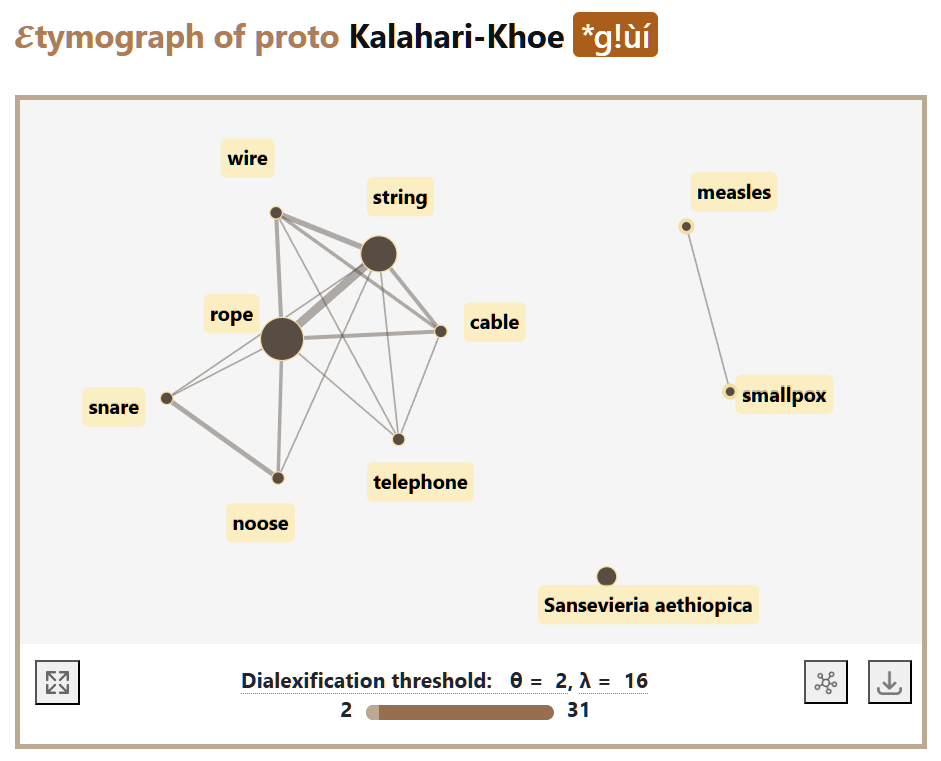
The purpose of 𝓔𝓿𝓸Sem is also to compare the lexical structures of one particular family – in this case, Khoe-Kwadi – with those of other families in the world.
Conversely, when viewing a Khoe-Kwadi etymograph on 𝓔𝓿𝓸Sem, you can click on the “source” icon  to view the full entry in the 𝓔𝓿𝓸𝕃𝕖𝕩 dictionary.

For any question you may have about this project, you can write to alexandre.francois@ens.psl.eu.
We are especially welcoming proposals by historical linguists who would like their etymological datasets to be published with us (in open access, free of charge for authors and readers).